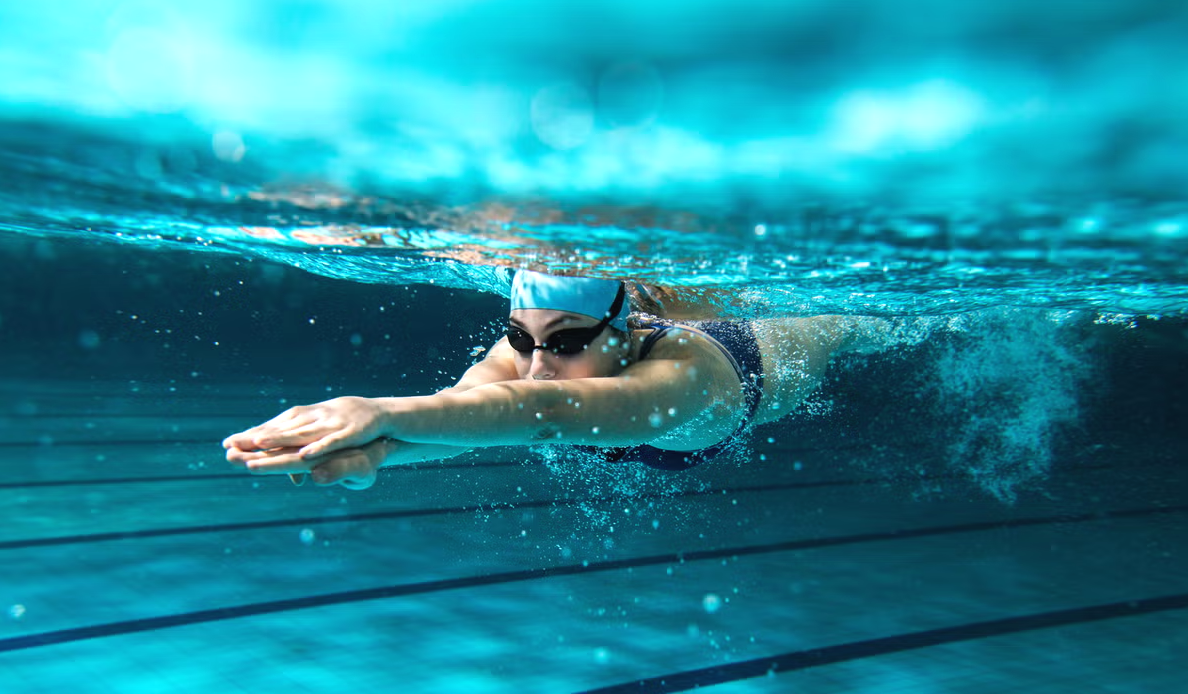
Two swimmers can cover the same distance at nearly identical speeds and finish in very different conditions. One reaches the wall with energy to spare. The other is exhausted, despite having worked considerably harder.Physical conditioning explains some of that difference. Technique often explains the rest. Raising the head too far during a breath increases resistance. A poorly timed kick interrupts momentum. Even a strong arm pull becomes less productive when the body moves out of alignment.
Effective swimming techniques address these problems by coordinating breathing, propulsion, balance, and timing. The objective is not necessarily to produce more force, but to use the available effort more efficiently.
For beginners, that often means developing water confidence and a reliable breathing rhythm. Experienced swimmers may focus on improving their underwater catch, controlling stroke rate, or maintaining efficiency as fatigue develops. Both groups benefit from understanding what happens during each stroke rather than simply accumulating more pool time.
The Four Main Swimming Strokes
Competitive swimming uses four principal stroke categories: freestyle, backstroke, breaststroke, and butterfly. Each involves a different combination of arm action, kicking, and breathing coordination.
Individual medley races follow a fixed order: butterfly, backstroke, breaststroke, and freestyle. Medley relays begin with backstroke, followed by breaststroke, butterfly, and freestyle. In both formats, the freestyle leg must use a stroke other than the three preceding styles.
Freestyle and Backstroke
Freestyle swimming almost always means front crawl, the fastest of the four conventional competitive swimming techniques. Strictly speaking, freestyle describes an event category rather than one particular stroke. Front crawl dominates because its alternating arm action allows swimmers to sustain high racing speeds.
Each arm moves through an underwater pulling phase and an above-water recovery. A flutter kick contributes to propulsion while helping stabilize the body. Rotation through the shoulders and hips allows the arms to move without excessive reaching across the centerline.
Breathing should follow that rotation. Turning the head sideways, with one goggle remaining close to the surface, limits unnecessary head lift. Exhaling underwater also makes the next inhalation less hurried.
Backstroke follows a comparable alternating pattern, except the swimmer faces upward. Breathing is easier to manage because the mouth generally remains above water. Maintaining direction presents a different challenge.
Effective backstroke technique depends on a stable head position, controlled rotation, and a productive underwater pull. The hips should remain near the surface rather than dropping into a seated position.
Competitive swimmers also use overhead flags and stroke counts to judge their distance from the wall. Without those references, approaching a backstroke turn consistently becomes considerably more difficult.
Breaststroke and Butterfly
Breaststroke uses simultaneous, symmetrical movements of the arms and legs. The stroke follows a coordinated sequence involving the arm pull, inhalation, forward arm recovery, kick, and streamlined phase.
The movements are connected rather than completely separate. Poor timing between the arm recovery and leg kick increases resistance and can interrupt forward momentum.
An effective breaststroke kick begins with the heels drawing toward the hips and the feet rotating outward. The legs then press backward before coming together. Simply spreading the knees apart produces relatively little useful propulsion.
Although breaststroke allows regular breathing, its mechanics are demanding. Swimmers must coordinate propulsion and recovery while avoiding an unnecessarily long glide, particularly at higher speeds.
The butterfly stroke requires a different movement pattern. Both arms recover above the water together, while a dolphin kick supports the body’s undulating motion.
In a conventional two-beat butterfly rhythm, one dolphin kick accompanies hand entry and another occurs near the end of the underwater arm pull. Together, they help coordinate propulsion and arm recovery.
The movement should travel through the torso, hips, and legs rather than originate from exaggerated knee bending. Excessive vertical motion increases drag and makes the next stroke harder to complete.
Short repetitions are usually more productive for swimmers learning butterfly than full lengths performed after coordination has deteriorated.
Building an Efficient Swimming Technique
Water creates substantial resistance, so improving alignment can be more productive than simply increasing effort.
Consider a freestyle swimmer whose hips consistently sit below the shoulders. Kicking harder may temporarily compensate, but it also raises energy expenditure. Correcting the underlying balance problem offers a more sustainable solution.
Body Position and Balance
In freestyle and backstroke, swimmers generally aim for a long, relatively horizontal position. The head stays naturally aligned with the spine, while the shoulders and hips rotate together.
During freestyle, looking forward continuously tends to lift the head and lower the hips. Directing the gaze toward the pool bottom, slightly ahead of the body, usually improves alignment.
Rotation also needs control. Too little restricts the arm movement. Too much can cause lateral swaying, forcing the swimmer to make unnecessary corrections.
A streamline drill helps demonstrate the importance of positioning. Push gently from the wall with both arms extended overhead, hands stacked, and the head between the upper arms. Maintain alignment while gliding a short, comfortable distance before surfacing.
Practice under appropriate supervision and avoid deliberate breath restriction. The objective is to understand how body position influences resistance, not to maximize underwater distance.
Breathing and Stroke Coordination
Swimming breathing technique requires inhalation to fit naturally into the stroke cycle. Poor timing can disrupt balance even when the arm and leg movements are otherwise effective.
Freestyle swimmers commonly breathe every two or three arm strokes. Neither pattern is universally superior. Breathing every two strokes provides more frequent access to air during demanding efforts, while alternating sides can help develop coordination.
Exhalation should begin underwater. Holding the breath until the head turns often produces a rushed inhalation and unnecessary movement.
Breathing frequency must also match the intensity of the effort. Deliberately restricting oxygen intake offers no necessary advantage for developing swimming endurance and introduces avoidable risks.
Breaststroke and butterfly require different timing. During breaststroke, inhalation occurs as the upper body rises through the arm pull. In butterfly, the swimmer generally breathes near the end of the underwater pull, returning the head downward before hand entry.
Practicing these patterns slowly makes it easier to identify coordination problems before increasing pace.
Swimming Drills That Improve Technique
Swimming drills isolate individual movements so swimmers can address weaknesses without managing every component of a complete stroke simultaneously.
The most useful exercise depends on the problem. Someone whose legs sink during freestyle may need balance work rather than additional arm-strength training. A swimmer who loses rhythm while inhaling may benefit from practicing rotation separately.
Several exercises address common technical issues:
- Side-kicking drill: Maintain a sideways position with the lower arm extended and the upper arm near the hip. A steady flutter kick develops balance and controlled rotation.
- Catch-up freestyle: Keep one arm extended until the recovering hand approaches it. This emphasizes forward extension and timing, although the deliberate pause should not become part of normal racing technique.
- Single-arm freestyle: Use one arm for propulsion while keeping the other extended or at the side. This exposes differences in rotation, breathing, and underwater pulling.
- Backstroke rotation drill: Maintain a flutter kick while rotating the shoulders and hips together, keeping the head relatively stable.
- Breaststroke kick with a board: Practice drawing the heels toward the hips, rotating the feet outward, and pressing backward without excessive knee separation.
- Butterfly body-dolphin drill: Develop a controlled wave through the torso, hips, and legs while avoiding exaggerated knee bending.
A technically correct 25-meter repetition is often more useful than a longer drill performed with deteriorating coordination.
Video feedback can reveal errors that are difficult to recognize in the water. Overhead footage may expose crossover during freestyle hand entry, while a side view can show excessive head lift.
The final step is transferring the correction into normal swimming. Alternating drills with short lengths of the complete stroke helps establish that connection.
Training for Speed and Endurance
Swimming training should reflect the intended distance and performance goal. A 50-meter sprinter needs a different balance of intensity and recovery from someone preparing for a 1,500-meter event.
Both require technical consistency, but their workouts place different demands on speed, aerobic conditioning, and muscular endurance.
Interval Training
Interval training divides swimming into repeated efforts separated by planned recovery periods. This allows swimmers to maintain a target pace without sustaining the same intensity continuously.
Consider eight 50-meter freestyle repetitions with 20 seconds of rest between efforts. Rather than sprinting through the first length, the swimmer aims to maintain reasonably consistent times across the entire set.
Repetition distance changes the training objective. Short efforts of 25 or 50 meters can support swimming speed when recovery is sufficient. Longer repetitions of 100 or 200 meters are commonly used for aerobic conditioning and pace control.
Rest periods matter just as much. Brief recovery makes the workload more continuous, while longer breaks allow faster efforts and greater attention to stroke quality.
If times decline sharply, the swimmer may need to reduce the pace, increase recovery, or shorten the set. The appropriate adjustment depends on the intended training outcome.
Longer Aerobic Sessions
Longer continuous swims and extended interval sets develop the ability to maintain movement over time. Pacing becomes particularly important as distance increases.
A swimmer preparing for a 400-meter race might begin with repeated 100-meter efforts before progressing toward longer repetitions. Recreational swimmers can use the same principle by alternating steady swimming with short breaks.
Starting too quickly often leads to shortened strokes and rushed breathing. A sustainable opening pace makes it easier to maintain consistent movement through the final lengths.
Training volume should increase gradually. Adding substantial distance before technique becomes reliable can reinforce inefficient mechanics and increase shoulder loading.
Aerobic conditioning also contributes to shorter competitive events, although sprint specialists generally devote more training attention to high-speed efforts and adequate recovery.
How to Structure a Swimming Workout
A practical swimming workout combines preparation, focused training, and recovery. The proportions depend on ability and the intended purpose.
The following 1,200-meter session suits a recreational swimmer who can already complete repeated lengths comfortably.
| Session | Distance | Purpose |
| Easy freestyle and backstroke | 200 m | Warm up and establish rhythm |
| Technique drills | 4 × 50 m | Improve balance and stroke control |
| Steady freestyle | 4 × 100 m | Develop aerobic endurance |
| Moderate-to-fast freestyle | 4 × 50 m | Practice controlled speed |
| Easy swimming | 200 m | Cool down |
| Total | 1,200 m |
Recovery periods should reflect fitness and the ability to maintain technique. The faster repetitions involve controlled acceleration rather than uncontrolled maximum-effort swimming.
For swimming for beginners, a shorter session of 400 to 600 meters may be more appropriate, with frequent breaks and additional attention to breathing.
Experienced swimmers can introduce target times, increase the main set, or alternate strokes according to their training goals.
Common Swimming Mistakes and How to Fix Them
Technical errors can persist even among swimmers who regularly complete substantial distances. The problem is often not a lack of effort, but movement that creates unnecessary resistance.
One common mistake is crossing the body’s centerline during freestyle hand entry. This can produce excessive side-to-side movement. Entering the water approximately in line with the shoulder helps maintain a straighter path.
Another involves kicking primarily from the knees. Large movements increase drag without necessarily improving propulsion. An effective flutter kick begins mainly at the hips, with natural knee flexion and relaxed ankles.
Breathing errors can also disrupt alignment. Swimmers who lift their heads excessively often struggle to keep their hips near the surface. Practicing sideways inhalation with controlled rotation addresses the underlying cause.
In breaststroke, beginning the next pull before completing the kick and reaching an effective streamlined position may interrupt momentum. Practicing the sequence at a moderate pace helps establish coordination without introducing an excessively long glide.
Butterfly swimmers sometimes exaggerate body undulation as their arms become tired. This creates additional resistance and makes recovery more difficult. Short repetitions with sufficient rest help preserve rhythm.
Corrections are generally easier to evaluate when swimmers focus on one problem at a time rather than attempting to change several movements simultaneously.
Taking Your Swimming to the Next Level
Improvement in swimming fitness is not measured exclusively through faster finishing times. Maintaining the same pace with less effort or steadier breathing can indicate greater efficiency.
Tracking a few consistent measurements helps assess progress. Useful examples include a comfortable 100-meter time, stroke count per length, and the ability to maintain similar times across repeated efforts.
Stroke count needs interpretation. Fewer strokes are not automatically better if excessive gliding reduces speed. Efficient swimming depends on finding an appropriate relationship between stroke length and stroke rate.
Competitive swimming also places considerable importance on starts, turns, and underwater phases. A strong push-off preserves momentum, while poor timing at the wall can cost valuable time.
Coaching becomes particularly useful when improvements slow. An experienced instructor can identify technical limitations that swimmers may struggle to recognize independently.
Recovery should remain part of the training plan. Increasing distance and intensity too quickly can contribute to shoulder overuse problems. Persistent pain deserves attention rather than being accepted as an unavoidable consequence of training.
Progress comes from matching training demands to current ability, evaluating results, and making specific adjustments as technique and conditioning improve.
FAQ
Which swimming stroke is best for beginners?
Freestyle and backstroke are common starting points, although the most suitable choice depends on comfort and coordination. Beginners should first develop floating ability, basic propulsion, and controlled breathing. Qualified instruction is especially valuable for anyone who lacks confidence in the water.
How often should beginners practice swimming?
Two or three sessions per week can be a reasonable starting point for many healthy adults. Short, consistent workouts provide regular opportunities to practice technique without accumulating excessive fatigue. Session length can increase as fitness improves.
What is the fastest swimming stroke?
Front crawl, normally used in freestyle events, is the fastest of the four conventional competitive strokes. Its alternating arm action and relatively continuous propulsion allow swimmers to maintain high racing speeds.
How can swimmers improve their breathing technique?
Start by exhaling underwater and coordinating inhalation with the natural movement of the stroke. During freestyle, turn the head with body rotation rather than lifting it forward. Breathing frequency should match the effort, and prolonged breath-holding exercises should be avoided without appropriate professional supervision.
Is swimming better for endurance or strength?
Swimming develops both, depending on training structure. Sustained moderate efforts primarily support aerobic endurance, while faster repetitions place greater demands on muscular power and coordination. Water provides resistance, although swimming does not fully replace dedicated strength training when maximum strength is the goal.